



The Brochu property is located in an elevated area of Los Chacayes, within The Vines of Mendoza development in Tunuyán, Mendoza.
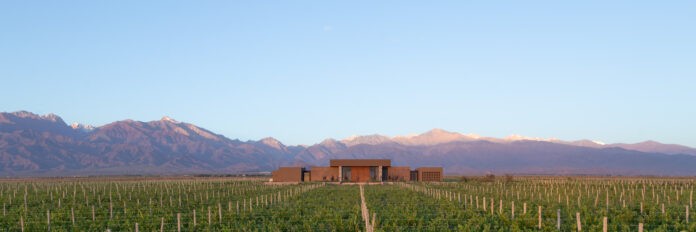
The site is actually a 6-hectare vineyard that, due to its elevation, naturally dominates the network of vines stretching out at the foothills of the Andes, whose presence is majestic and imposing, making everything else seem small—except for the sky, perceived as a celestial vault.
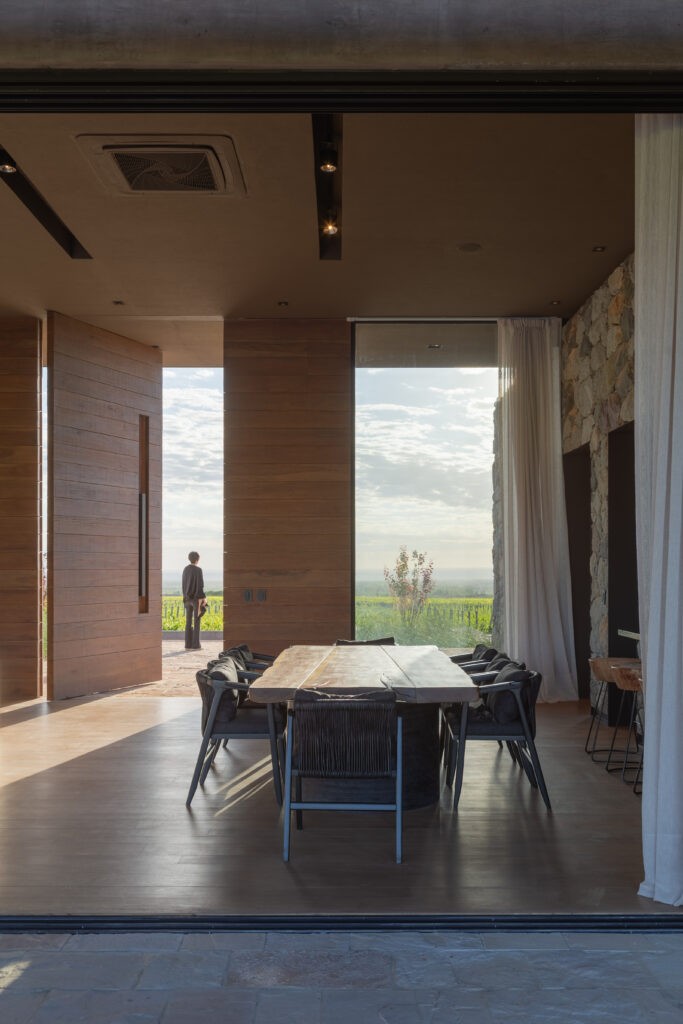
The project began with a clear concept: to create a building that would establish an architectural presence which, through the careful handling of scale, geometric order, and materiality, harmonizes with the vineyards and the Andes mountain range. A villa with central, intermediate, and open spaces designed to offer a complete human experience—ranging from elevation and contemplation to recreation and social or family gatherings.
The Villa: Brief Historical Context
According to the Royal Spanish Academy, a villa is a country house used for recreation, situated in isolation in the countryside. As a basic principle, we can consider this definition accurate, though not fully complete, since the villa is an architectural typology with a rich history that, over the centuries, has undergone conceptual changes according to the needs of each era.
For his part, Palladio is associated with three key points: an alternative space to city life, a place to connect with nature, and a space for reconnection. These three core principles perfectly express some of the needs of modern humans and formed the conceptual basis for Andrea Palladio’s design of his villas.
Brochu House
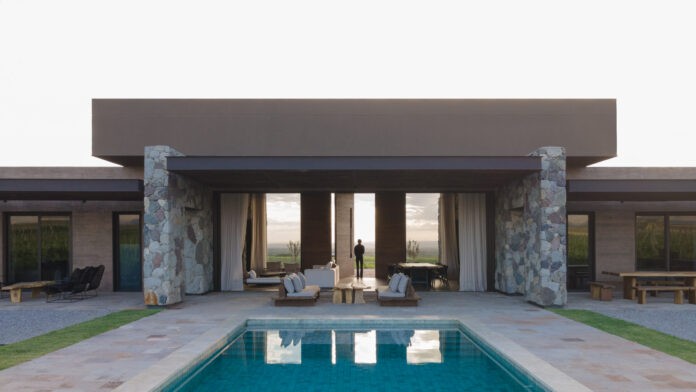
The rustic and the sophisticated are harmoniously linked, symbolizing the relationship between the mundane and the elevated—essential characteristics of human nature and its needs.
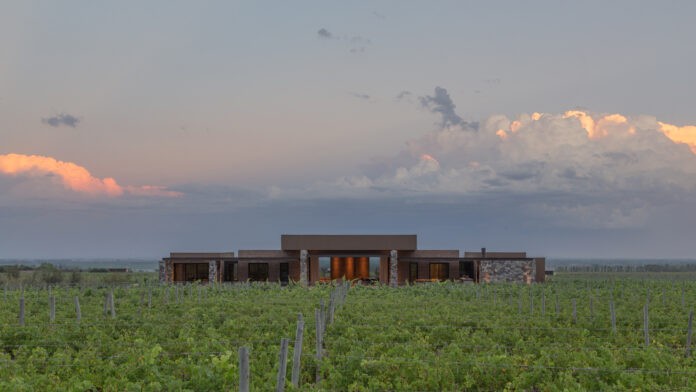
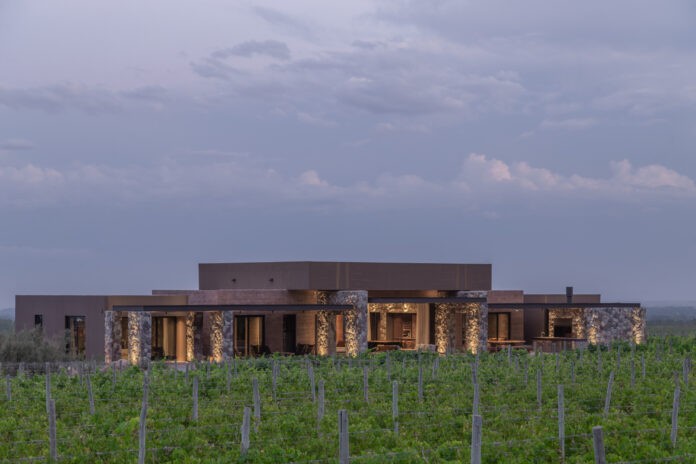
The villa is a space for elevation through reading, study, and music, as well as for recreation and social life. Brochu Villa integrates into the landscape, expanding in all directions and organizing itself through a variety of views. It is lifted from the ground by a strong base, giving rise to a prominent staircase. The centralized volumetry establishes a hierarchy in the relationship between the masses.
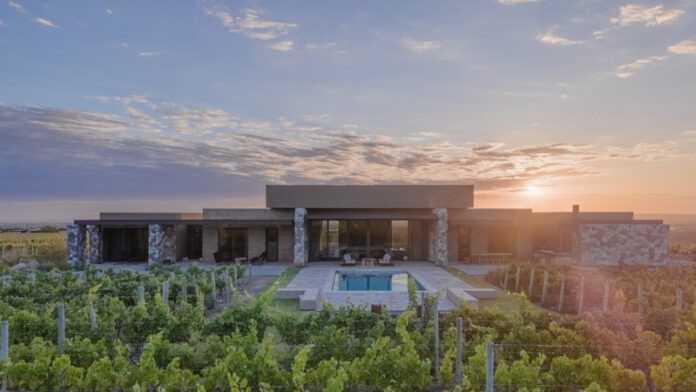
A distinctive feature is that in the middle of this vineyard there is a grove of native chacay trees; it seems that they were preserved when planting the varietals. In this way, the presence of this natural flora coexists with the vineyards, creating a point of special value.
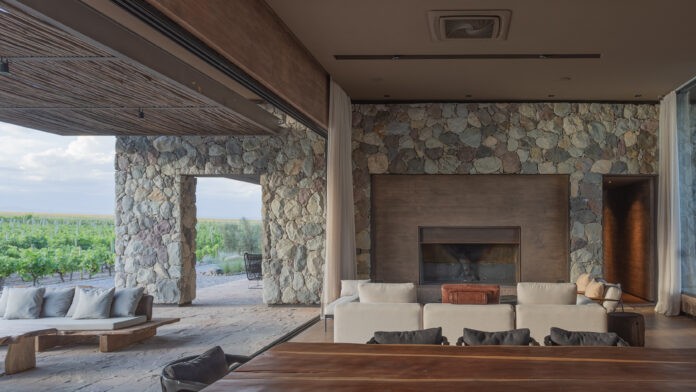
Along the East-West axis, a prominent central volume is proposed, notable for its height, within which the main activities of the house take place. On both sides of this central volume, along a North-South axis and composed of lower-massed elements, the overall volumetry of the house is completed with a symmetrical order and a carefully considered rhythm; these lateral wings house bedrooms and service areas.
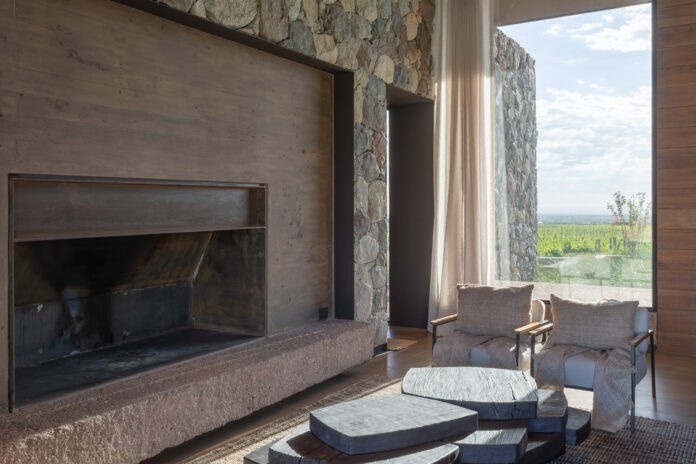
The character of the house is synthetic, with pure volumes stripped of ornamentation.
Palladio proposes a way of living that is absolutely modern, and its expression through forms, spaces, and relationships serves as an archetype, an inspiration.
Technical Sheet
Project: Brochu House
Location: The Vines of Mendoza – Los Chacayes, Tunuyán
Area: 500 m²
Architect: González Olsina & Vega Arquitectos
Collaborators: Arq. Nicolás Telechea, Arq. Bianca Brescia, Arq. Cecilia Blanco
Technical Direction: Integra CPM
Interior Design: Arq. Consuelo Delgado
Landscape Design: Eduardo Vera
Lighting Design: Aspen Lumiere
Structural Engineering: Ing. Raúl Batellini
Construction: GR Housing
Photography: Luis Abba Studio
Key Suppliers
Lighting: Aspen Lumiere
Faucets and Sanitaryware: Hipercerámico