



The map of Argentina’s luxury destinations marks a spot that no self-respecting bon vivant would skip if they can pay close to a thousand dollars per night. This is The Vines of Mendoza, one of the most acclaimed sites in Argentina according to leading publications focused on experiential tourism in Latin America. But it doesn’t only offer accommodation, the delights of Francis Mallmann’s Siete Fuegos, or helicopter tours: it also provides the opportunity to purchase a plot of land (around 300,000 dollars per hectare) among vineyards and mountains and fulfill the dream of producing your own wine with the grapes you see from the window and the infrastructure set up for it.
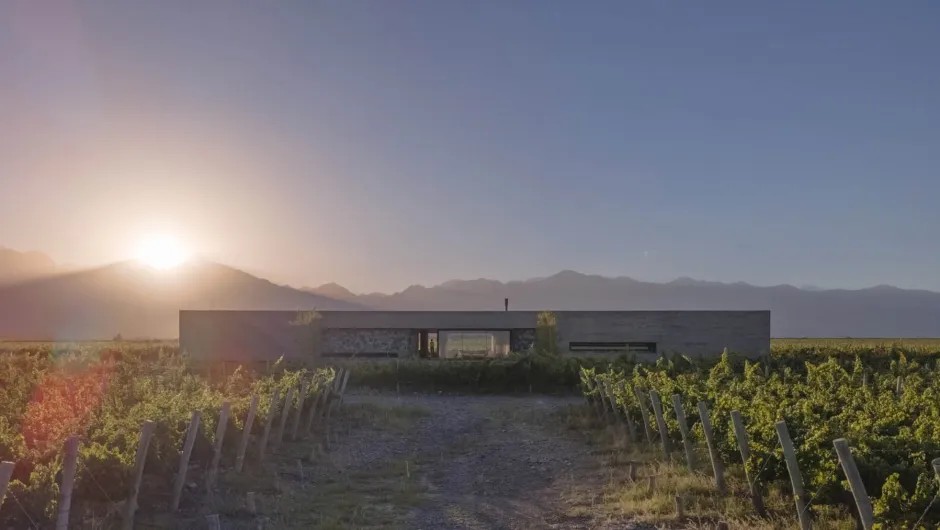
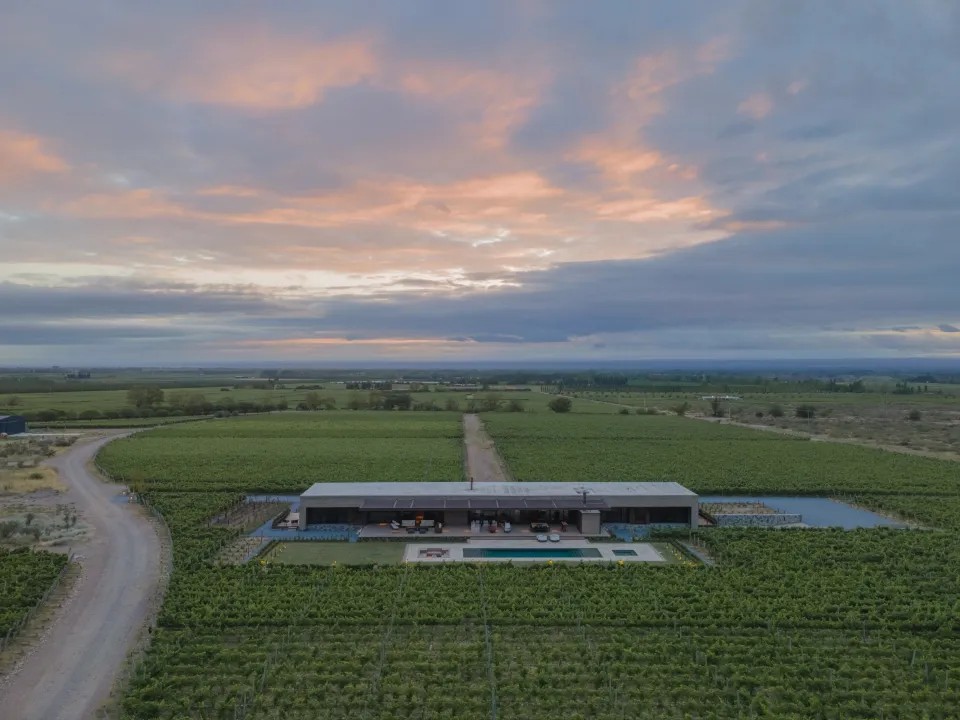
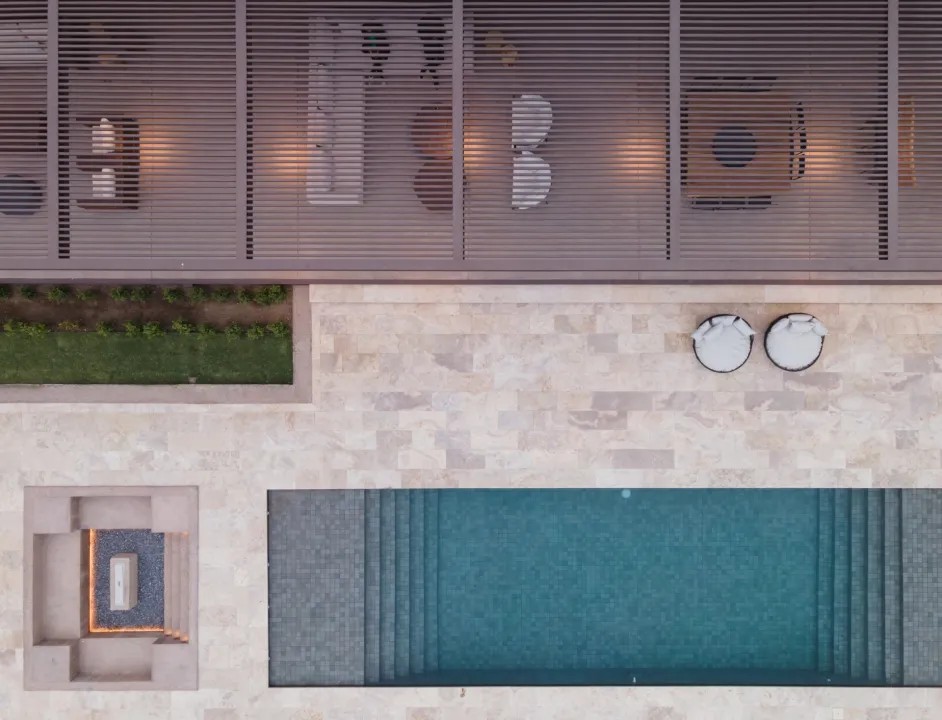
This is the case of Scott, an American passionate about wine and its surrounding culture, who built his impressive house among two and a half hectares of vineyards in this development in Los Chacayes, Tunuyán, 85 km southwest of the city of Mendoza. It is set at the foothills of the Andes mountain range, in the Uco Valley, one of the country’s most prestigious and sought-after wine regions.
The Project
Within a landscape of open horizons and profound Andean silence, the program consisted of a dwelling conceived as a refuge in direct relation with the vineyards and the mountain range. The house offers a shared space for living, dining, and cooking, four bedrooms, a workspace, a wine cellar, and outdoor leisure areas, explain architects González Olsina and Vega.
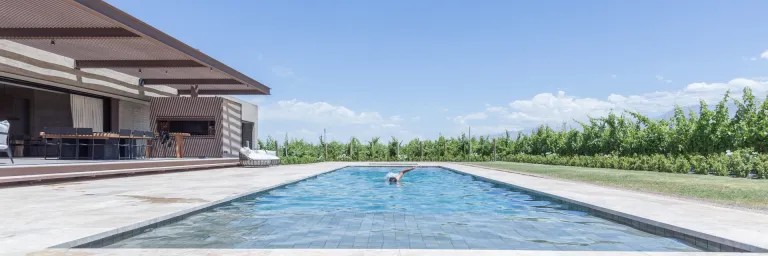
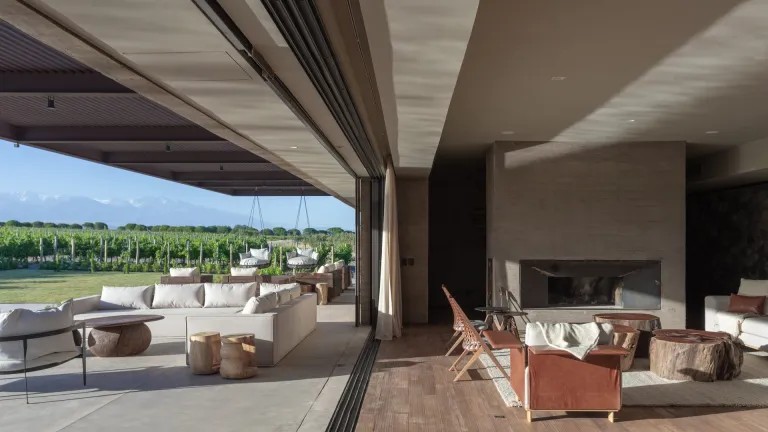
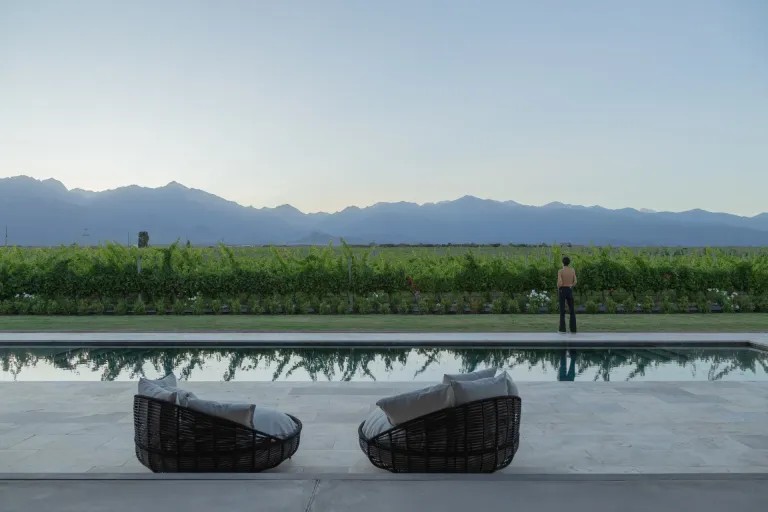
“The guiding idea,” they continue, “was based on an understanding of the territory as a horizontal and silent geometry, where architecture aligns with the existing natural order—the cosmos. Conceived as an inhabited line, arranged parallel to the mountain range, it organizes the functions and directs each space toward the Andean horizon. Its transverse layout reflects a desire for belonging: that every area of dwelling participates in the same act of contemplation.”
Three Principles of the Design Strategy
The design strategy arises from three principles. The first is horizontality as a form of integration, understood both as a compositional gesture and as an attitude toward the landscape; through a linear circulation on the eastern side, the functions are articulated and arranged toward the western Andes.
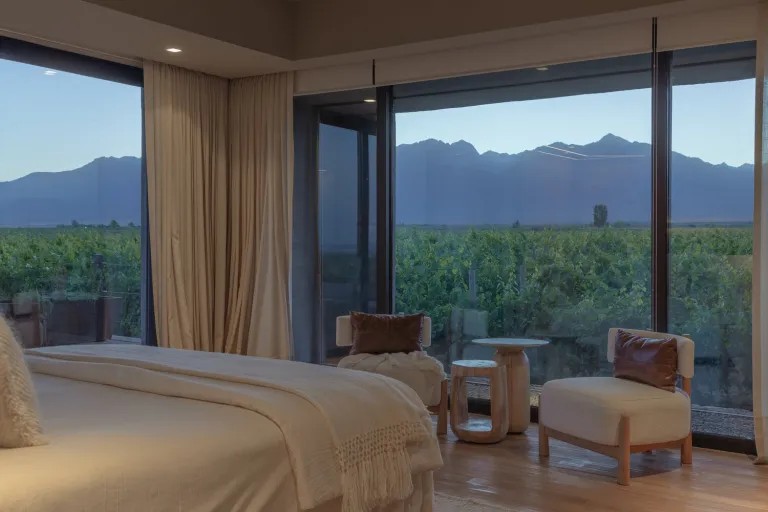
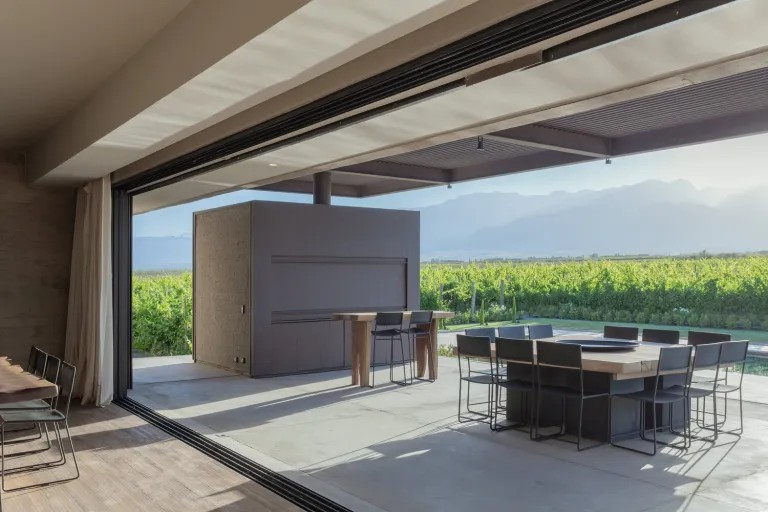
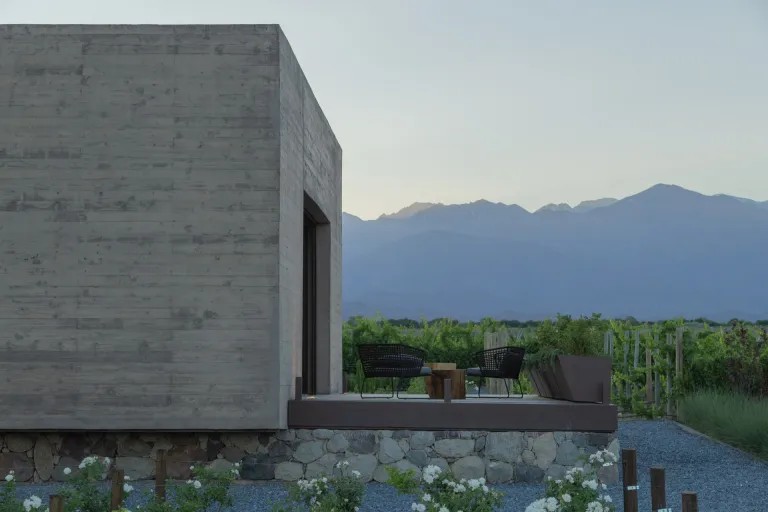
The second is the platform as boundary and mediation, a plane that lifts the gaze above the vineyards, allowing it to connect with the mountains while providing the proper distance from the ground.
The third is materiality as continuity with the environment: the local stone and pigmented concrete are expressions of the same mineral nature. Mass, texture, and tone merge into a material continuity with the mountain range. The concrete, with its serene and mineral presence, provides weight and timelessness. The stone, in its irregularity and density, anchors the building to the site, describe the architects.
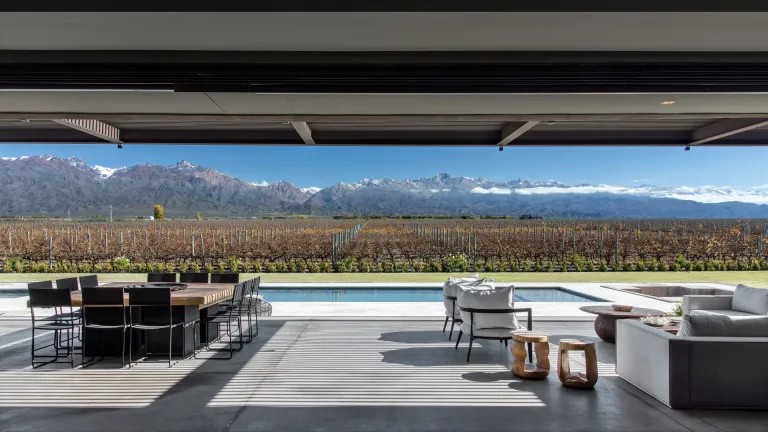
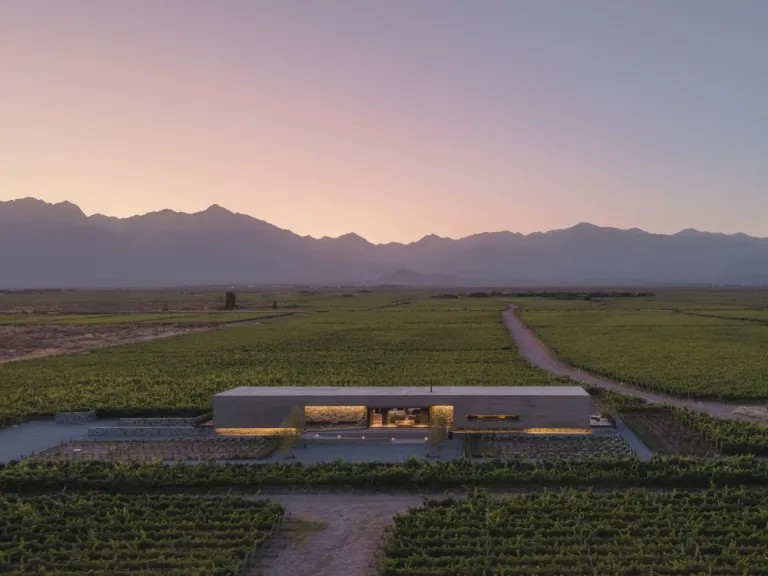
The Objective? An architecture that seeks to endure without imposing itself, to integrate without dissolving. “A quiet, tectonic presence that emerges from the land as an extension of its own structure. The overall composition responds to a criterion of synthesis: a geometric language, proportions guided by the ancient notion of number as a principle of beauty, and a balance between opacity and transparency,” they add.
González Olsina & Vega, based in the city of Mendoza, has carried out other developments in the Uco Valley, as well as in other regions of Argentina, Uruguay, and Brazil.
Technical Sheet
Location: Uco Valley, Mendoza
Area: 750 m²
Studio: González Olsina & Vega Arquitectos
Year: 2023
Photography: Luis Abba