



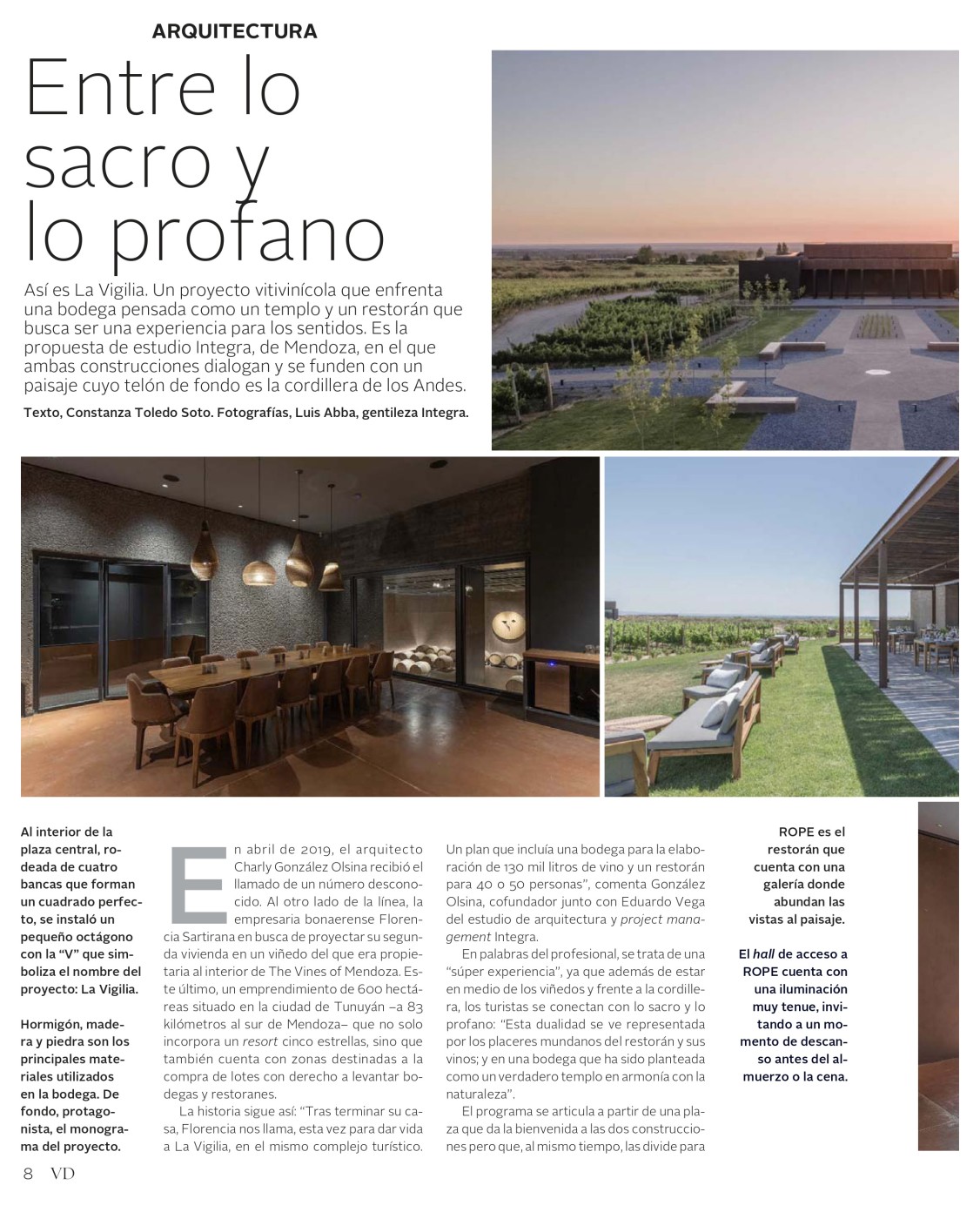
Inside the central plaza, surrounded by four benches forming a perfect square, a small octagon was installed featuring the “V” symbolizing the project’s name: La Vigilia.
Concrete, wood, and stone are the primary materials used in the winery. In the background, prominently displayed, is the project’s monogram.
In April 2019, architect Charly González Olsina received a call from an unknown number. On the other end was Florencia Sartirana, a businesswoman from Buenos Aires, seeking to design her second residence on a vineyard she owned within The Vines of Mendoza. This development spans 600 hectares in the city of Tunuyán—83 kilometers south of Mendoza—and not only includes a five-star resort but also areas where clients can purchase plots with the right to build wineries and restaurants.
The story continues: “After completing her house, Florencia called us again, this time to bring La Vigilia to life within the same resort complex—a plan that included a winery for producing 130,000 liters of wine and a restaurant for 40 to 50 guests,” explains González Olsina, co-founder of the architecture and project management firm Integra along with Eduardo Vega.
In the professional’s words, it is a “super experience,” since, in addition to being amidst the vineyards and facing the Andes, visitors connect with both the sacred and the profane: “This duality is represented by the worldly pleasures of the restaurant and its wines, and by a winery conceived as a true temple in harmony with nature.”
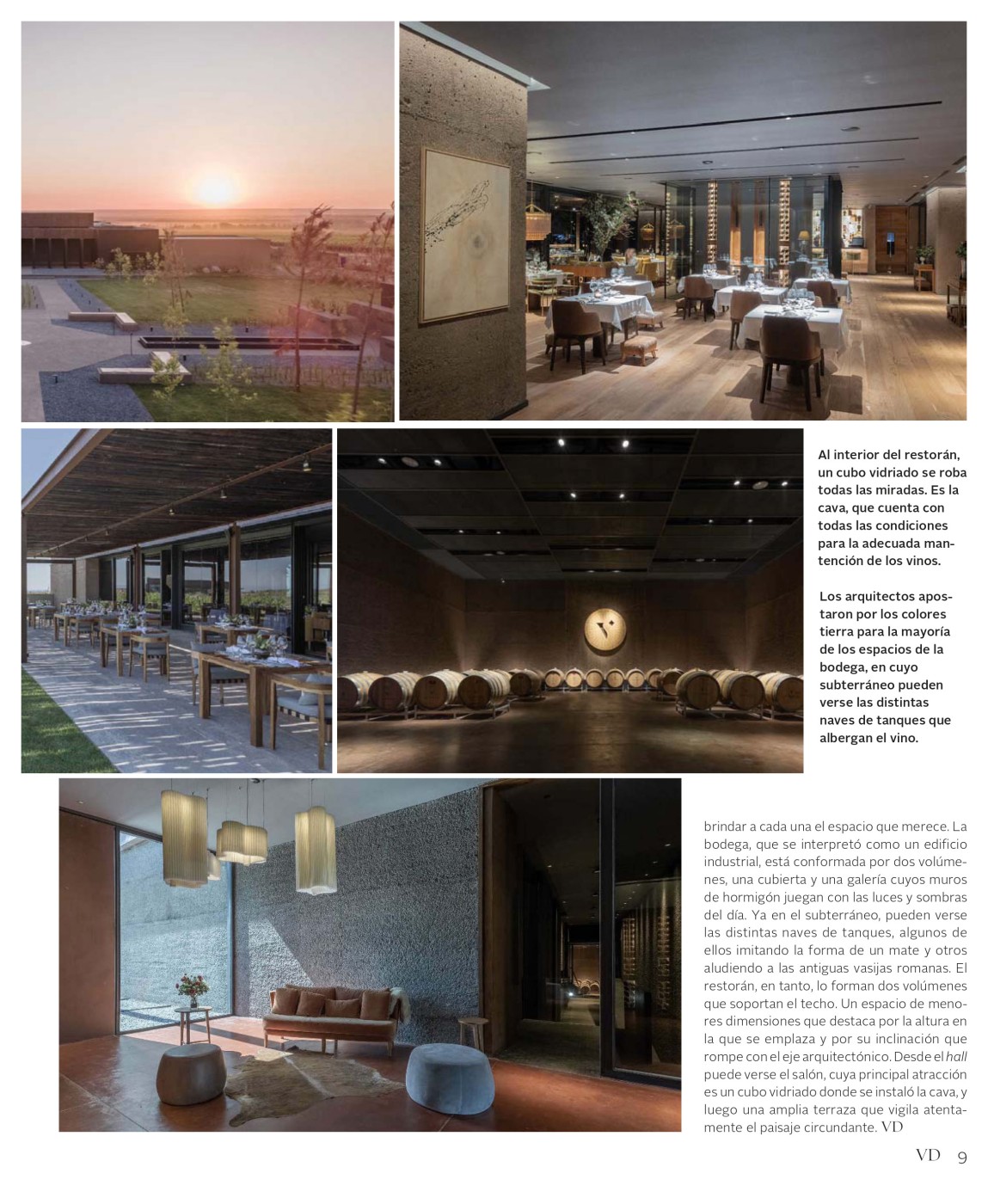
The program is organized around a plaza that both welcomes the two buildings and simultaneously separates them, giving each the space it deserves. The winery, interpreted as an industrial building, consists of two volumes, a roof, and a gallery whose concrete walls interact with the day’s light and shadow. In the underground level, the different tank halls can be seen—some shaped like a mate cup, others referencing ancient Roman vessels. The restaurant, in turn, consists of two volumes supporting the roof. A smaller-scale space, it stands out for the height at which it is set and its inclined position, breaking the architectural axis. From the hall, the main dining room can be seen, highlighted by a glass cube housing the wine cellar, followed by a large terrace that carefully surveys the surrounding landscape.
ROPE is the restaurant featuring a gallery that offers abundant views of the surrounding landscape.
The entrance hall to ROPE has very subtle lighting, inviting a moment of pause before lunch or dinner.
Inside the restaurant, a glass cube captures all attention. It is the wine cellar, equipped with all the necessary conditions for proper wine storage.
The architects chose earthy tones for most of the winery’s spaces, where the underground level reveals the different tank halls that store the wine.
Text: Constanza Toledo Soto
Photographs: Luis Abba, courtesy of Integra